Skoda Octavia 2020 review

Overview
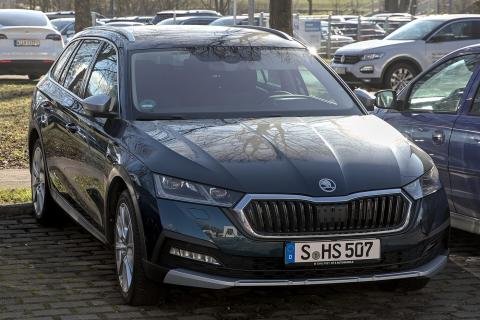
The fourth-generation Octavia reached UK order books in June 2020, and it did so at a price that put the rest of the family-car class on notice: from £22,390 on the road for a 1.5 TSI SE First Edition hatch. Built on the same MQB architecture as the Mk8 Volkswagen Golf, the new Octavia arrived sharper-looking, bigger inside and loaded with driver-assistance technology that had previously lived further up the price ladder. Rivals were the usual suspects — the VW Golf, Ford Focus, Vauxhall Astra, Toyota Corolla, Hyundai i30, Kia Ceed and the mechanically related SEAT Leon — but few of them could match the Skoda for sheer space per pound, with hatch boot space growing to 600 litres and the estate offering 640 litres.
At launch the engine choice was deliberately narrow: a 1.5-litre turbo petrol with 150PS badged 1.5 TSI, and a 2.0-litre TDI diesel in 115PS and 150PS forms. The 1.5 TSI (147bhp, 250Nm, six-speed manual) is the sweet spot — Parkers records 0-60mph in 8.2 seconds, a 143mph top speed and WLTP combined economy of up to 52.3mpg. The 150PS diesel is the long-distance hero: WhatCar timed 0-62mph in 8.7 seconds, with WLTP economy around 60-67mpg depending on version. The entry 1.0 TSI (108bhp, 200Nm) arrived a little later in 2020 at a lower price point, trading 10.5-second 0-60 pace for WLTP figures up to 54.9mpg. A seven-speed DSG automatic was offered on most engines, often bundled with 48-volt mild-hybrid e-TEC hardware, and a 204PS plug-in hybrid iV followed with a claimed electric-only range of up to 43 miles.
Skoda kept the trim structure refreshingly simple at launch: SE First Edition, the fleet-focused SE Technology and range-topping SE L First Edition, with S, SE and SE Drive filling in below later. Even the launch SE First Edition came with autonomous emergency braking, lane assist, an 8.25-inch touchscreen with full smartphone connectivity and no fewer than five USB-C ports. SE L First Edition added 17-inch alloys, microsuede upholstery, heated front seats, ambient lighting, the Columbus infotainment system and adaptive cruise control. The new Octavia earned a full five-star Euro NCAP rating in the 2020 test, scoring 92 per cent for adult occupants, 88 per cent for children and 73 per cent for vulnerable road users. The vRS performance flagship arrived in October 2020, launching as a 245PS 2.0 TSI DSG from £31,495, with diesel and plug-in hybrid vRS versions following.
As a used buy in 2026, the 2020 Octavia is one of the strongest-value family cars on the market: Parkers values for a 1.0 TSI SE hatch now sit around £8,500-£15,000, with most decent 1.5 TSI cars changing hands between about £9,000 and £13,000. The 1.5 TSI manual is the safest pick — strong, economical and simple. Check that all software updates and recall work have been carried out (early cars suffered infotainment and assistance-system glitches, and there have been several recalls including a June 2020 eCall software fix and a January 2024 DSG campaign). On diesels, confirm regular AdBlue top-ups and a DPF-friendly usage history — these engines suit long runs, not school-run duty. Service history matters more than mileage on these cars; Skoda's warranty was three years or 60,000 miles, so most 2020 cars are now out of cover.
UK price from: £22,390
Specifications
| Engine | 1.5-litre turbocharged petrol (TSI), 1498cc, 4-cylinder |
| Power | 147 bhp (150PS) at 5,000rpm |
| Torque | 250 Nm |
| 0-60 mph | 8.2 seconds |
| Top speed | 143 mph |
| Transmission | 6-speed manual (7-speed DSG optional on most engines) |
| Drive | Front-wheel drive |
| Fuel economy | 42.2-52.3 mpg (WLTP combined) |
| CO2 emissions | 123-151 g/km |
| Boot space | 600 litres (hatch); 640 litres (Estate) |
| Euro NCAP | 5 stars (2020 test — 92% adult, 88% child, 73% vulnerable road users) |
| Warranty | 3 years / 60,000 miles (UK) |
Features
- 8.25-inch touchscreen infotainment with Apple CarPlay and Android Auto as standard on SE First Edition
- Front Assist autonomous emergency braking and Lane Assist fitted to every launch model
- Five USB-C charging ports including one in the rear-view mirror for dashcam connection
- Simply Clever details: umbrella in the driver door, ice scraper in the fuel flap, funnel in the washer-fluid cap
- Up to nine airbags including driver knee and rear side airbags on SE Technology
- Travel Assist with predictive adaptive cruise control offering level-2 assisted driving
- 600-litre hatch boot (640 litres in the Estate), one of the largest in the class
- Columbus infotainment with voice control, remote access and online services on SE L First Edition
Common parts & prices
| Part | Price (GBP) | Notes |
|---|---|---|
| Engine oil filter | £8 | Pattern part; service item for the 1.0/1.5 TSI EA211 evo engines — check correct fitment |
| Cabin (pollen) filter | £12 | Pattern part; worth changing yearly — the Octavia's large cabin benefits from a fresh filter |
| Front brake pads (axle set) | £35 | Pattern part; check wear sensors are included |
| Front brake discs (pair) | £60 | Pattern part; often replaced with pads around 50-60k miles |
| Timing belt kit (1.5 TSI) | £120 | Pattern kit with belt, tensioners and idlers; get a quote from a VAG specialist before buying |
| Water pump (1.5 TSI) | £45 | Pattern part; sensible to replace together with the timing belt as access labour overlaps |
Pros
- Enormous interior and 600-litre boot for family-car money — space rivals cars a class above
- Excellent launch pricing, undercutting the equivalent VW Golf by a clear margin
- 1.5 TSI engine blends genuine pace (0-60mph in 8.2s) with up to 52.3mpg WLTP economy
- Full five-star Euro NCAP rating with strong adult and child occupant scores
- Comfortable, refined long-distance manners and low running costs, especially in diesel form
Cons
- Early cars were plagued by software glitches in the infotainment and driver-assistance systems
- Cabin materials, while solid, feel a class below a VW Golf in places
- Soft suspension makes the standard car feel floaty over crests — only the vRS brings real driver appeal
- Touch-sensitive slider controls for volume and climate can be fiddly to use on the move