Nissan Juke 2020 review

Overview
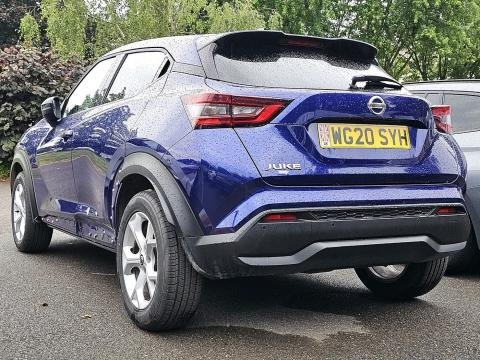
The second-generation Nissan Juke (chassis code F16) arrived in UK showrooms at the start of 2020, built in Sunderland where Nissan had invested heavily to retool the line. It was a car Nissan desperately needed to get right: the original Juke had invented the small-crossover segment in Britain but was getting old, cramped and outclassed. The new car grew in every direction, matured its styling and launched with UK on-the-road prices from £17,395 for the entry Visia to £23,895 for the range-topping Tekna+, with a limited Premiere Edition at £23,995 and a £1,400 premium for the automatic gearbox.
Under the bonnet there was exactly one choice at launch: a 1.0-litre three-cylinder turbocharged petrol badged 1.0 DiG-T 117, producing 117PS with up to 200Nm of torque in overboost, driving the front wheels through either a six-speed manual or a seven-speed dual-clutch automatic. The manual covers 0-62mph in 10.4 seconds and tops out at 112mph, while WLTP combined economy reaches 47.9mpg with CO2 from 112g/km — respectable for the class, though rivals such as the Ford Puma offered punchier and leaner options. Practicality took a big step forward, with boot space up from 354 to 422 litres (1,305 litres with the seats folded). The trim ladder runs Visia, Acenta, N-Connecta, Tekna and Tekna+, and even the base car is generously equipped: LED headlights, cruise control, intelligent emergency braking with pedestrian and cyclist detection, lane departure warning with intervention and traffic sign recognition all come as standard.
Safety was one of the new Juke's strongest cards. Tested by Euro NCAP in December 2019, it earned a full five-star rating with 94 per cent for adult occupant protection, 85 per cent for child occupants, 81 per cent for vulnerable road users and 73 per cent for safety assist — a huge improvement on the old car, which had scored a dismal 41 per cent for pedestrian protection. Higher trims add Nissan's ProPilot semi-autonomous assistance, a 360-degree camera, blind spot intervention and rear cross-traffic alert, putting the Juke among the best-equipped small crossovers of its era.
As a used buy in 2026, the 2020 Juke looks like strong value. Dealer prices cluster between roughly £10,400 and £12,850 according to Honest John's guide, with an average advertised figure around £13,000, and clean low-mileage Teknas changing hands near £11,000. The 1.0 turbo three-pot is a proven unit shared with the Micra and demands little beyond a full service history (12,500 miles or 12 months). Before buying, run the registration through the DVSA's free recall checker — no model-specific UK recall campaign could be verified for the 2020 F16, but checking is free insurance. Watch for kerbed 19-inch alloys on Tekna and Tekna+ cars, check the infotainment touchscreen and 360-degree camera work, and remember that a hybrid did not exist in 2020: the 1.6 hybrid only joined the range in 2022, so any 2020 car will be the pure-petrol 1.0.
UK price from: £17,395
Specifications
| Engine | 1.0 DiG-T 117, 999cc turbocharged 3-cylinder petrol |
| Power | 117PS (115bhp) at 5,250rpm |
| Torque | 200Nm (148lb ft) at 1,750rpm with overboost |
| 0-62 mph | 10.4 seconds (6-speed manual) |
| Top speed | 112mph |
| Transmission | 6-speed manual (7-speed DCT automatic optional, not on Visia) |
| Drive | Front-wheel drive |
| Fuel economy | 47.9mpg WLTP combined (manual; 45.6-47.9mpg across the range) |
| CO2 emissions | 118g/km WLTP combined (112-118g/km across the range) |
| Boot space | 422 litres seats up, 1,305 litres seats folded |
| Kerb weight | 1,199kg |
| Warranty | 3 years / 60,000 miles |
Features
- Full Nissan Intelligent Mobility safety suite standard on every trim, including intelligent emergency braking with pedestrian and cyclist recognition
- LED headlights, daytime running lights and tail lights fitted across the whole range
- 8-inch touchscreen with Apple CarPlay and Android Auto from Acenta trim upwards
- NissanConnect sat-nav with TomTom live traffic on N-Connecta and above, plus intelligent key and electric handbrake with auto hold
- 19-inch alloy wheels, Bose sound system with headrest speakers and 360-degree around-view camera on Tekna
- ProPilot semi-autonomous driving assistance and two-tone paint personalisation options on Tekna+
- Drive mode selector with Eco, Standard and Sport settings, plus active ride control and active trace control
Common parts & prices
| Part | Price (GBP) | Notes |
|---|---|---|
| Front brake pads (set, pattern part) | £35 | Fits 1.0 DiG-T F16; check pad wear at each 12,500-mile service |
| Front brake discs (pair, pattern part) | £58 | Replace with pads if lipped or scored; 19-inch Tekna wheels need checking for kerb damage at the same time |
| Oil filter | £12 | Genuine-pattern spin-on filter for the HR10DDT 1.0 turbo engine; change every 12 months or 12,500 miles |
| Engine air filter | £17 | Panel filter for the 1.0 turbo; a clogged filter dulls throttle response on the small three-cylinder |
| Cabin pollen filter | £14 | Behind the glovebox; replace yearly to keep the air-con effective |
| Clutch kit (manual models) | £225 | Pattern three-piece kit for the 6-speed manual; budget labour on top — check for slip on higher-mileage examples |
Pros
- British-built in Sunderland with a full five-star Euro NCAP rating from the December 2019 tests
- Generous standard safety kit — even the £17,395 Visia gets autonomous emergency braking and lane intervention
- Big practicality gain over the old car: 422-litre boot and noticeably more rear legroom
- Proven 1.0 turbo three-cylinder returns up to 47.9mpg WLTP and keeps insurance and servicing cheap
- Distinctive styling with two-tone paint and interior personalisation on higher trims
Cons
- Only one engine at launch — no diesel and no hybrid until the 1.6 hybrid arrived in 2022
- Rear seats are still tight for three adults despite the growth spurt
- The £1,400 seven-speed DCT automatic blunts performance compared with the manual
- Tekna+ prices pushed past £25,000 with options, where rivals offered more power